 ENCIETY
Many businesses face the same paradox: customer satisfaction scores are high, quarterly reports look good, and presentations run smoothly. Then a major account fails to renew, or sales in one segment fall without warning.
“Why? Didn’t our customers say they were satisfied?” That question is a sign that the current system is missing something. A serious approach to customer experience (CX) helps uncover it.
Who Needs CX?
Every business with customers. The urgency differs, though:
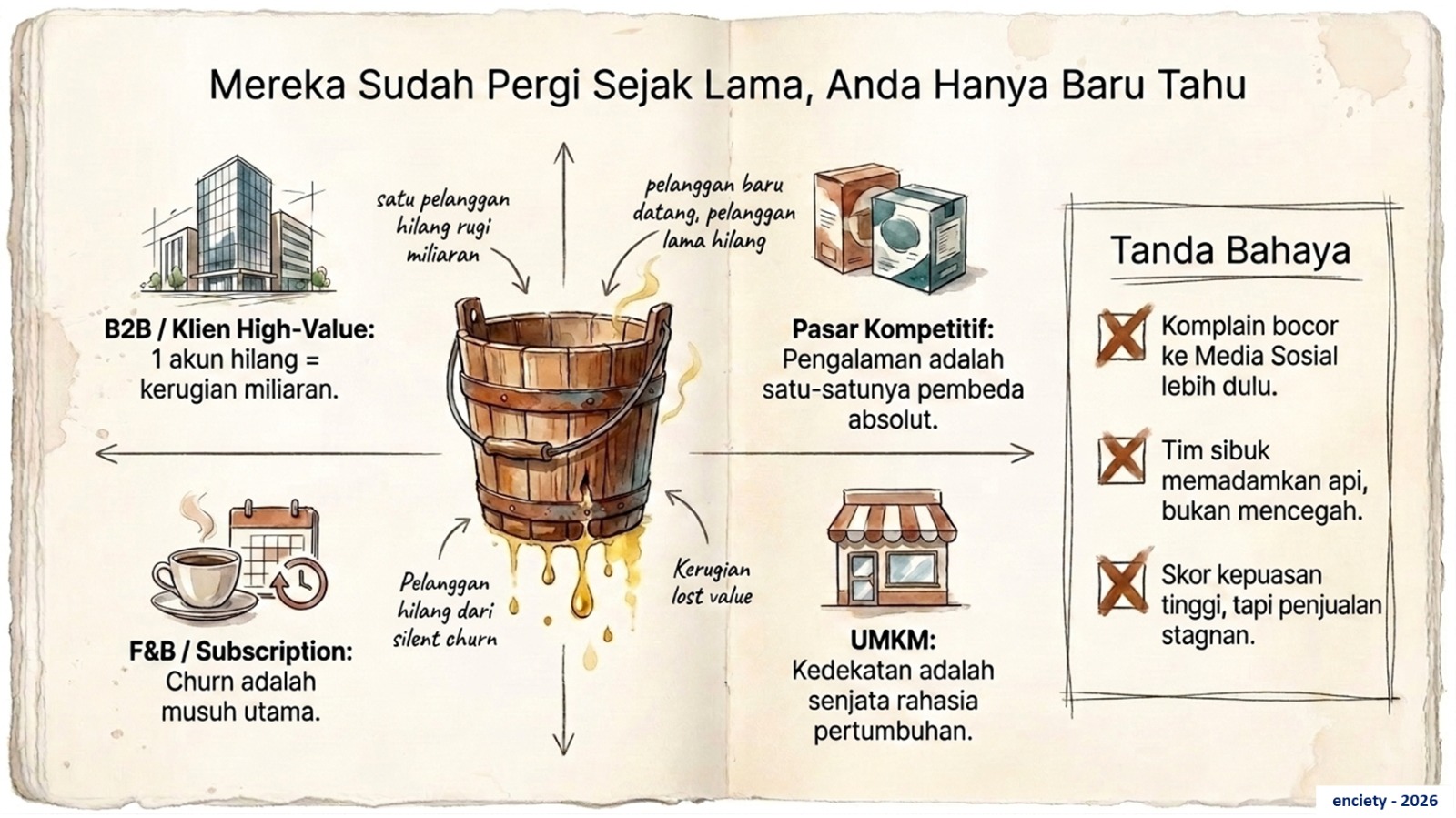
- Businesses with a few high-value customers. In B2B, losing one account can mean hundreds of millions or even billions of rupiah in annual revenue. CX is an early-warning system for real financial risk.
- Businesses with hard-to-distinguish products. When offerings look alike, the experience can become the last meaningful point of difference.
- Businesses built on loyalty and repeat purchases. In food and beverage, retail, subscriptions, and e-commerce, churn often starts with a disappointing experience that nobody reports.
- Small businesses ready to grow. A shop that remembers a regular’s order, an online seller who replies quickly, and a service provider who follows up are all practicing CX. Those habits can support growth as the business scales.
Signs Your Business Should Take CX More Seriously
- You learn about complaints from social media or a third party.
- Your team spends its time putting out complaint fires instead of preventing them.
- You do not know why customers choose you—or why others decide not to buy.
- Satisfaction scores are high, but sales are flat or falling.
- There is no regular way to hear from customers.
If any of these sound familiar, you are not alone—and the situation can change.
Who needs CX, and why do we often realize it only after it is too late?
CX does not have to be expensive, require software, or need a dedicated team. A small business can begin with three steps:
- Ask directly. After a customer receives your product or service, ask, “What could we improve?” and record the answer.
- Look for patterns. Which complaints recur? Where do customers feel the most friction? Those patterns point to what to fix first.
- Close the loop. If a customer raises an issue and you address it, let them know. That simple follow-up can build real loyalty.
Simple, yet many large businesses still do not do it consistently.
This is the second article in “Talking CX: From Coffee Stalls to Corporations.”